Updated 2026-10-29 · Editorial archive: 2026-10-24. Archive grouping is separate from publication.
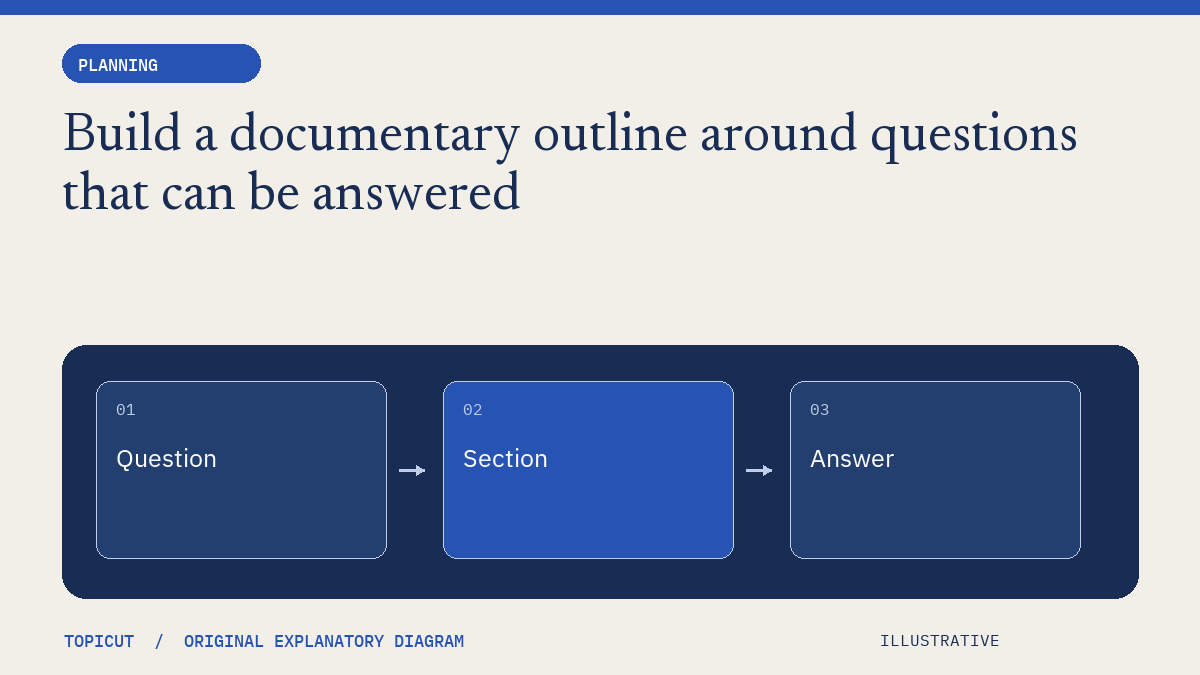
Build a documentary outline around questions that can be answered
A useful outline tells the writer what each section must resolve.
A useful outline tells the writer what each section must resolve. A list such as introduction, background and conclusion names positions without explaining what the viewer learns. Replace those containers with questions and connect each proposed answer to evidence before expanding the narration.
Make the decision explicit
Write a main question and three supporting questions. Give each section an intended answer, a source to inspect and a transition that explains why the next question follows. Where an answer remains uncertain, preserve the uncertainty in the outline. This makes missing research visible while the document is still cheap to change.
A worked example
For an invented navigation explainer, the main question is why a route changed. Section one establishes the original plan; section two examines the new constraint; section three compares the revised route with the initial goal. A draft budget of two, four and three minutes leaves one minute for orientation and closing in a ten-minute target. Those numbers are planning allocations, not measurements of finished speech.
Review before handoff
Read only the questions and transitions. If the story no longer makes sense, decorative prose is probably hiding a structural gap. Use a narration estimate after the questions are coherent, then replace the estimate with measured audio. An outline is a decision record; it is neither a fact check nor approval of the visuals.
Put the idea to work
Read script outline and use the related free workflow tool for its stated, limited task. Neither link replaces the review described above.
Reference and editorial notes
References checked October 29, 2026. Numerical and fictional scenarios are illustrative unless explicitly identified otherwise. The cover is an original Topicut explanatory diagram, not a product screenshot or a measurement.
A reusable outline you can fill in
Use this text template before drafting narration. It separates an interesting subject from a question that evidence can answer.
Subject:
One question:
Provisional answer (not yet verified):
Claim 1 → primary source → what the source actually establishes
Claim 2 → primary source → uncertainty or conflicting evidence
Claim 3 → visual available → source and reuse review still needed
Opening: show the question, without revealing an unsupported answer
Middle: test the answer against the evidence
Ending: answer only as strongly as the evidence permits
For an Apollo 13 explainer, “How did the crew return?” is still broad. “What role did the lunar module play after the accident?” sets a narrower research task. Find the relevant mission documentation before turning that question into a causal statement. A photograph can establish what a scene looked like; it does not, by itself, prove why an engineering decision succeeded.
Use the research-question definition to tighten the inquiry, then estimate script runtime. If the outline needs more time, remove a secondary question before compressing every sentence. Keep unverified claims visibly marked in your working document.
Continue: Script planning
- Words to minutes
- Plan a 15-minute video script with an honest timing budget
- Production brief
- Research question
- Documentary thesis
- Estimate script runtime before recording
Working on a specific brief? Request a sample to discuss scope and availability. Self-serve video generation remains closed.
More Posts
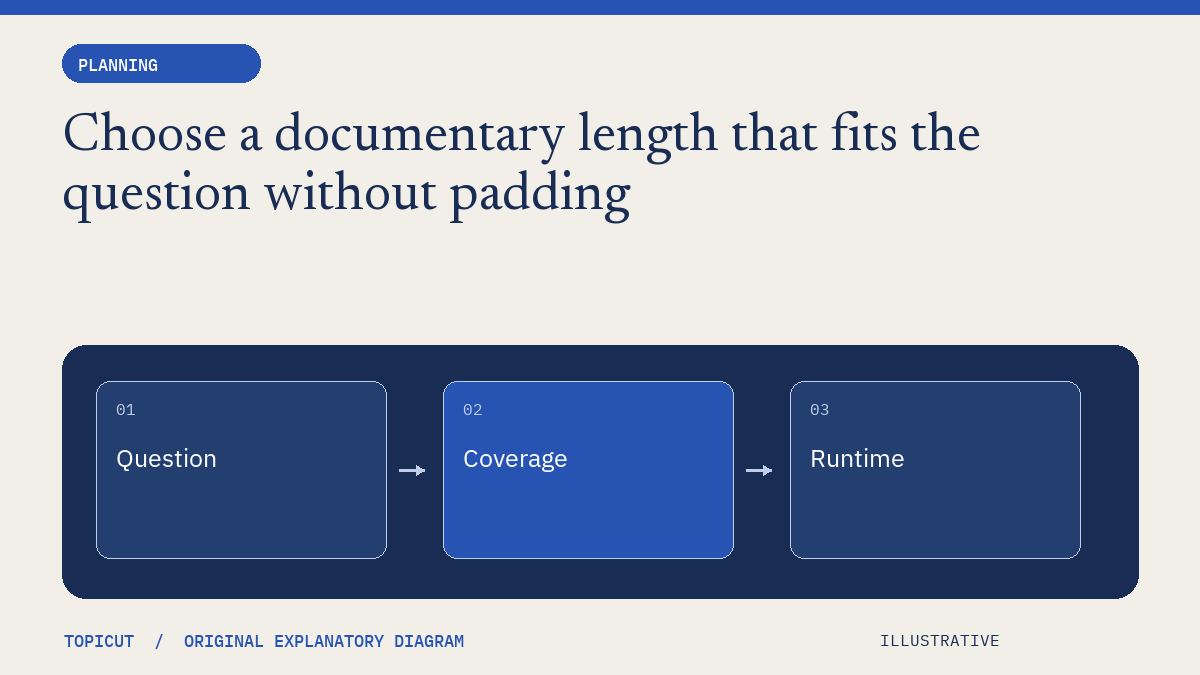
Choose a documentary length that fits the question without padding
Runtime should follow the amount of explanation the question needs.

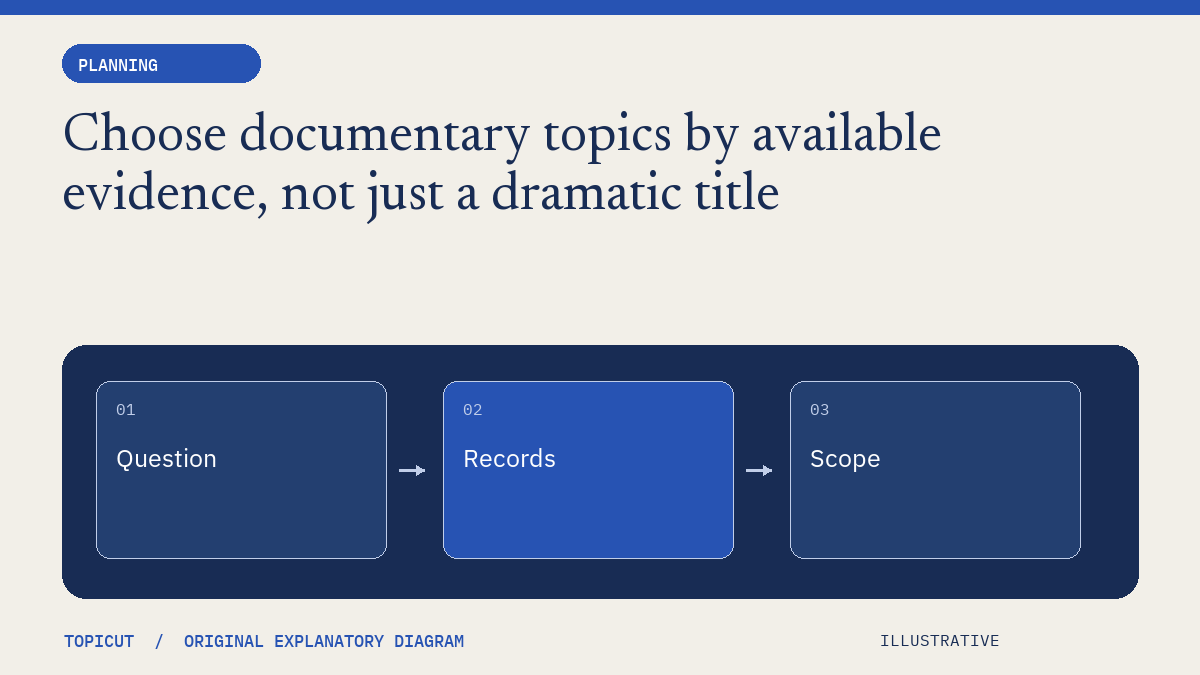
Choose documentary topics by available evidence, not just a dramatic title
A topic can sound compelling and still be expensive to support visually.
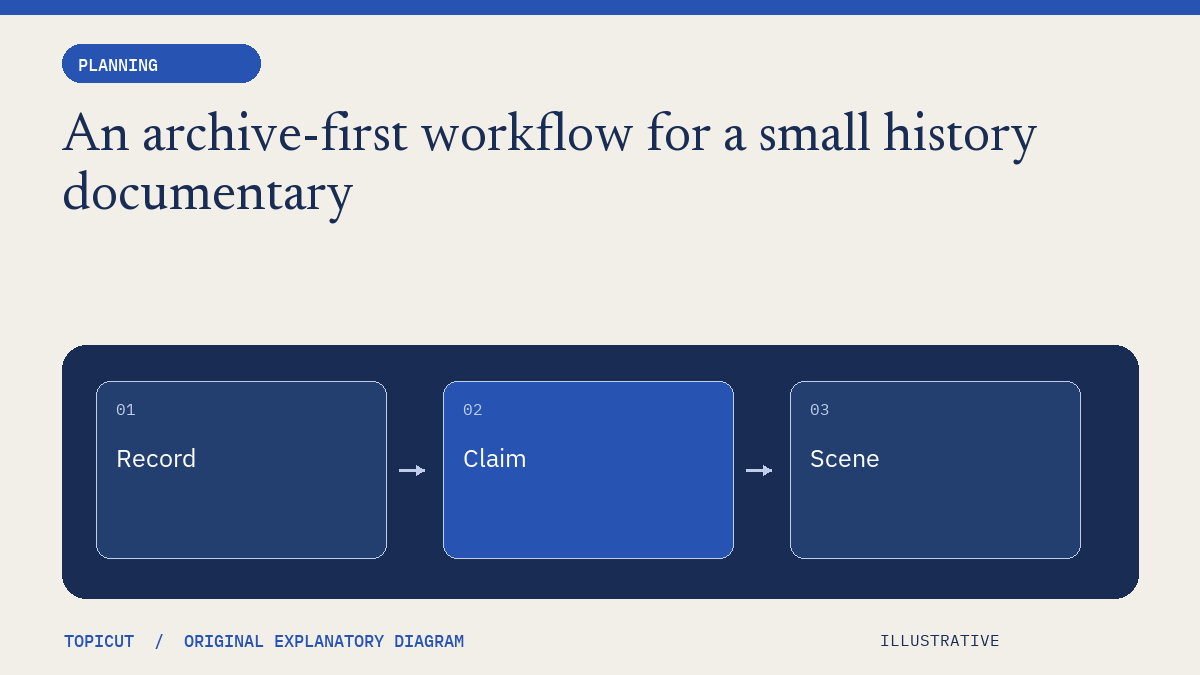
An archive-first workflow for a small history documentary
An archive-first workflow starts with records you can inspect rather than a finished script looking for convenient pictures.