Updated 2026-10-29 · Editorial archive: 2026-10-24. Archive grouping is separate from publication.
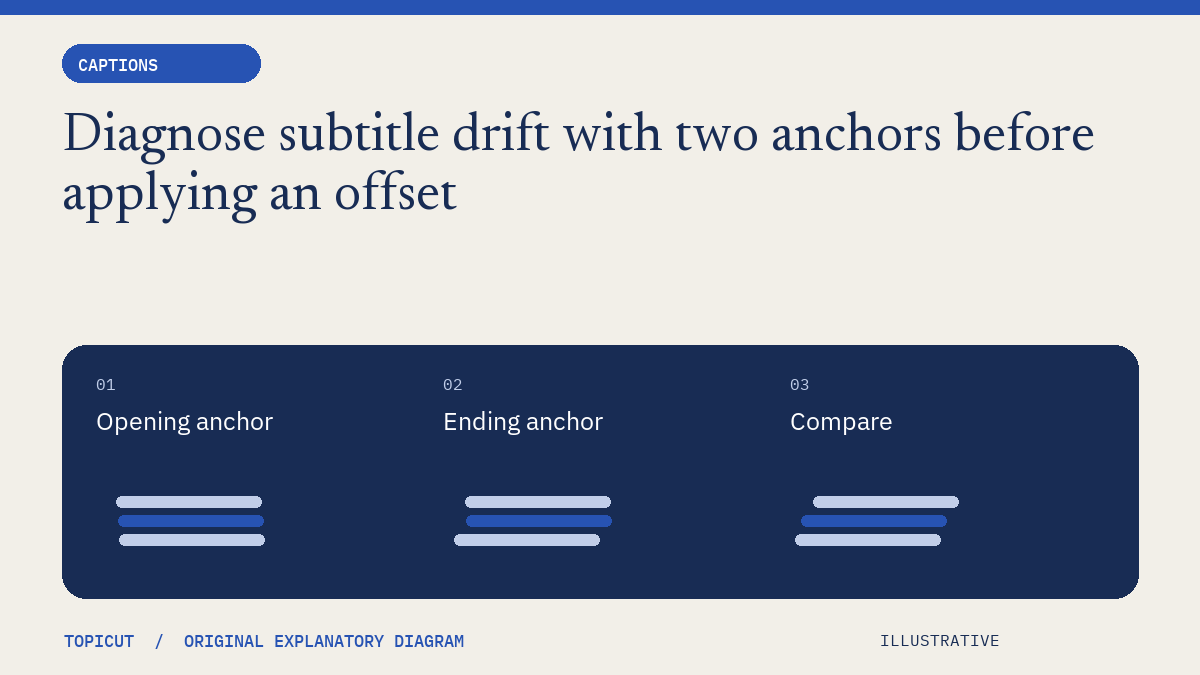
Diagnose subtitle drift with two anchors before applying an offset
If subtitles are correct near the beginning but wrong near the end, changing one offset may improve one location while making another worse.
If subtitles are correct near the beginning but wrong near the end, changing one offset may improve one location while making another worse. First determine whether the error is constant, changing gradually or introduced by a particular edit.
Make the decision explicit
Choose a clear spoken phrase near the start and another near the end. Record the expected time and the subtitle time at both locations. If the differences match, a uniform shift is a reasonable controlled test. If they differ, inspect the source version, edits and timing assumptions. Do not automatically stretch every caption from only two observations.
A worked example
In an illustrative example, the opening caption needs a delay of one second and the final caption needs a delay of five seconds. A one-second shift fixes the opening but leaves four seconds of late-stage error. If an extra four-second pause was inserted halfway through the video, the appropriate correction may be localized rather than a gradual rescale. More anchors help distinguish these possibilities.
Review before handoff
Keep the original and test changes against the same video revision. Topicut's free shifter applies a declared constant offset; it does not discover or repair drift. After any edit, inspect a phrase before and after each cut as well as the end. A synchronization decision should be supported by observed anchors, not by whichever offset makes the first line look right.
Put the idea to work
Read subtitle drift and use the related free workflow tool for its stated, limited task. Neither link replaces the review described above.
Reference and editorial notes
References checked October 29, 2026. Numerical and fictional scenarios are illustrative unless explicitly identified otherwise. The cover is an original Topicut explanatory diagram, not a product screenshot or a measurement.
Record the error before changing the file
Write expected speech time minus subtitle start time for each anchor. A positive result means that caption needs to move later. The following numbers are a diagnostic example, not measurements from a customer video.
| Anchor | Subtitle starts | Speech starts | Needed shift |
|---|---|---|---|
| Opening | 00:05.000 | 00:06.250 | +1.250 seconds |
| Middle | 05:00.000 | 05:01.250 | +1.250 seconds |
| Ending | 10:00.000 | 10:01.250 | +1.250 seconds |
All three agree here, so a constant offset is a reasonable test. If the ending instead needs +5.250, stop: applying +1.250 everywhere leaves a four-second error there. Look for an inserted shot, different video edit, or timing conversion before assuming a linear stretch.
Follow the shift-and-convert tutorial with the downloadable two-cue fixture. Save the shifted file under a new name. Check the same three anchors against the actual audio, including whether the spoken phrase continues into the next shot. Topicut’s time shifter changes timestamps; it cannot listen to the recording or detect an edit.
Continue: Subtitle editing
- SRT ↔ VTT converter
- Subtitle time shifter
- Fix a constant subtitle delay, then check readability
- SRT vs VTT: convert plain subtitles and check the result
- SRT subtitles
- WebVTT
- Subtitle synchronization
- Shift subtitles and convert SRT to VTT
Working on a specific brief? Request a sample to discuss scope and availability. Self-serve video generation remains closed.
More Posts
Why two caption reading-speed counters can disagree
A character-per-second result is only meaningful when the counting convention is known.

Plain caption conversion and styled subtitles need different workflows
A subtitle converter can preserve words and timestamps while still being unable to represent every feature in a source file.
Prioritize speech-recognition review without trusting confidence scores alone
An automatic transcript can look convincing while containing a wrong surname, number or negation.