Updated 2026-10-29 · Editorial archive: 2026-10-29. Archive grouping is separate from publication.
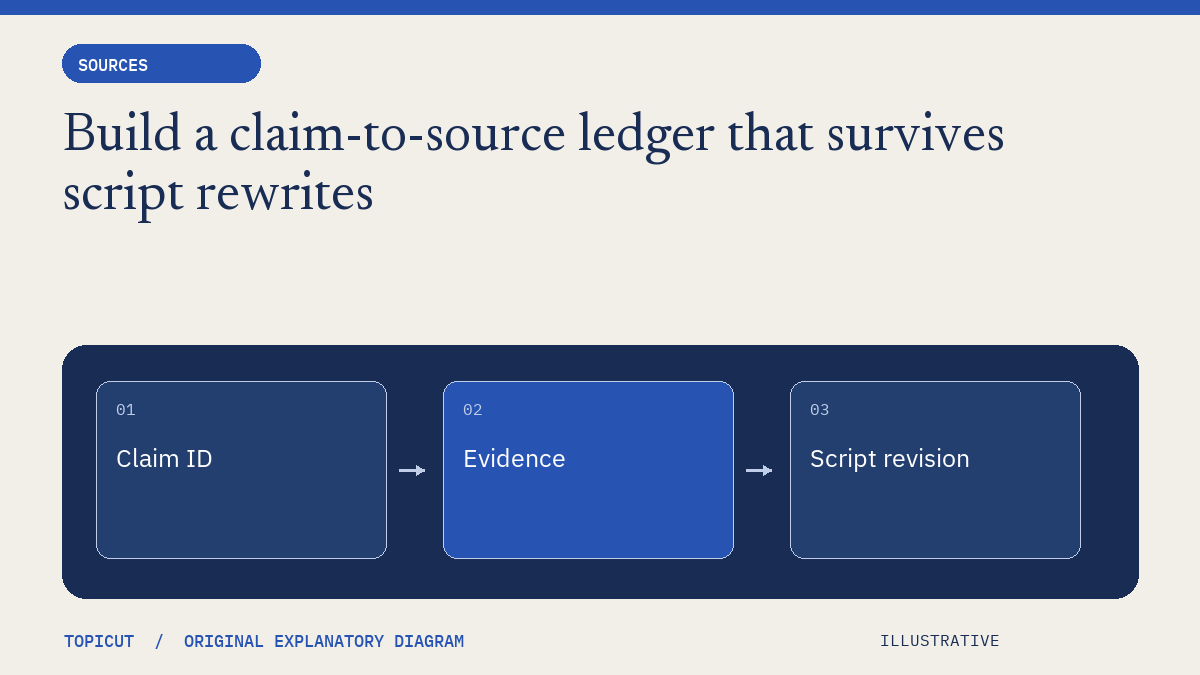
Build a claim-to-source ledger that survives script rewrites
A bibliography says which materials were consulted.
A bibliography says which materials were consulted. A claim ledger makes the relationship more precise: which assertion relies on which part of which source, with what qualification and review status.
Make the decision explicit
Give each important claim a stable identifier and quote or summarize only the necessary supporting location in your working record. Note whether the source supports a date, a quantity, a causal interpretation or an exact quotation. When rewriting, preserve the identifier or explicitly create a new claim instead of assuming that nearby citations still apply.
A worked example
An invented draft says a repair reduced delays by half. The evidence concerns one test over a specified period. A later rewrite says the repair solved the system's reliability problem. The source has not changed, but the claim has expanded. The ledger should expose that change before the stronger sentence reaches narration or a promotional description.
Review before handoff
Review disputed claims separately and retain alternative explanations. A source being primary does not make every interpretation of it correct. In the final description, a readable source list can help viewers investigate, but the internal ledger should retain the narrower mapping and the script revision it was checked against.
Put the idea to work
Read claim ledger and use the related free workflow tool for its stated, limited task. Neither link replaces the review described above.
Reference and editorial notes
References checked October 29, 2026. Numerical and fictional scenarios are illustrative unless explicitly identified otherwise. The cover is an original Topicut explanatory diagram, not a product screenshot or a measurement.
Use a claim-level handoff table
A bibliography alone does not show which sentence a source supports. Use one row for each factual claim, and preserve a location such as a page, section or timestamp.
| Field | What to enter |
|---|---|
| Claim ID | A stable local identifier such as C-01 |
| Script sentence | The exact current wording |
| Evidence location | Original document URL plus page/section |
| Support | What the source directly establishes |
| Limit | What it does not establish, and any disagreement |
| Visual | A separate asset record, if there is one |
| Review | Person, date and open questions |
If a source supports “the system was tested” but your sentence says “the test proved it would never fail,” revise the sentence. Do not fix the gap by adding the same citation again. Separate the factual observation from your interpretation.
Use the outline template before drafting and the source attribution builder only for the credit text supplied to it. The ledger and the credits solve different tasks: evidence supports claims, while an asset record describes the material and its stated reuse conditions. Neither is an automatic fact-check or legal clearance.
Continue: Sources and attribution
- Source attribution builder
- What to record from a Wikimedia Commons file page before editing
- Review individual NASA media credits instead of assuming every file is identical
- Primary source
- Secondary source
- Provenance
- Format supplied source records into a credit draft
Working on a specific brief? Request a sample to discuss scope and availability. Self-serve video generation remains closed.
More Posts
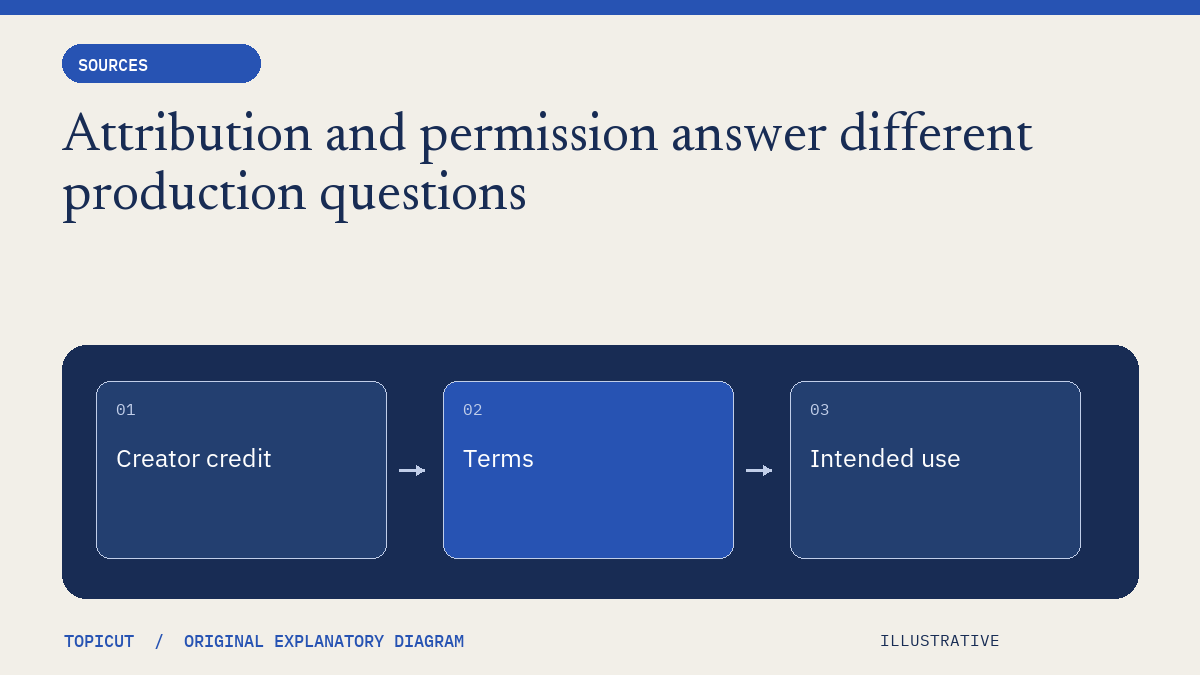
Attribution and permission answer different production questions
A source credit tells a viewer where material came from.

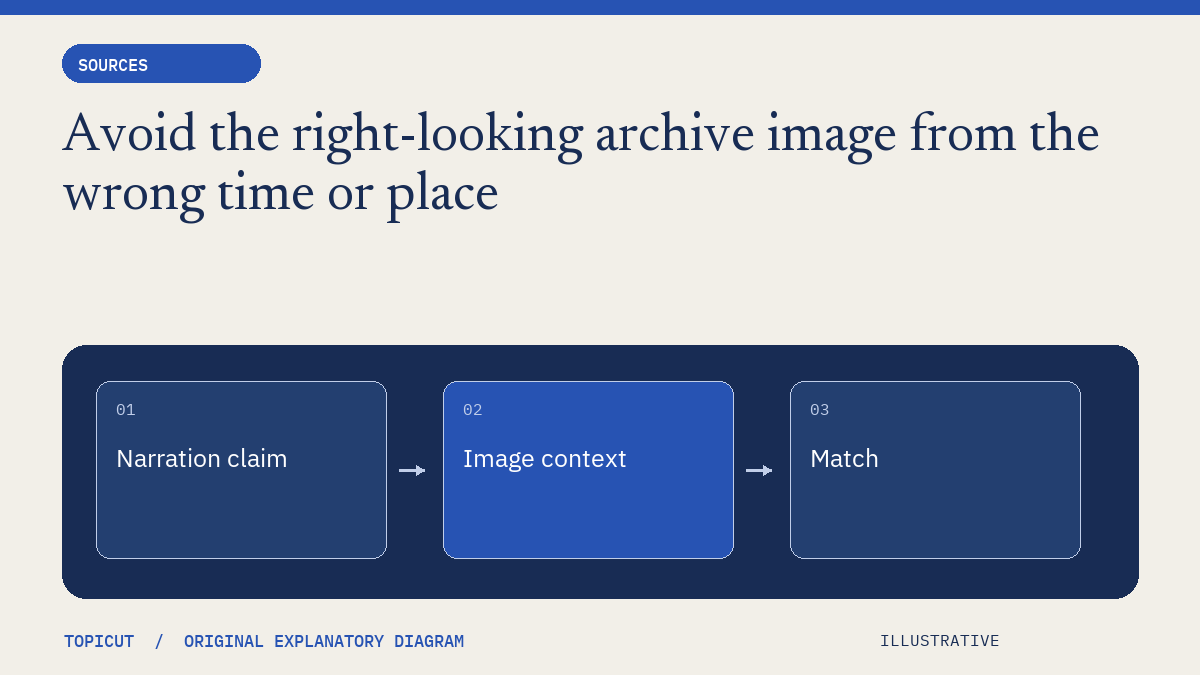
Avoid the right-looking archive image from the wrong time or place
An archive image can be visually plausible while contradicting the scene it accompanies.
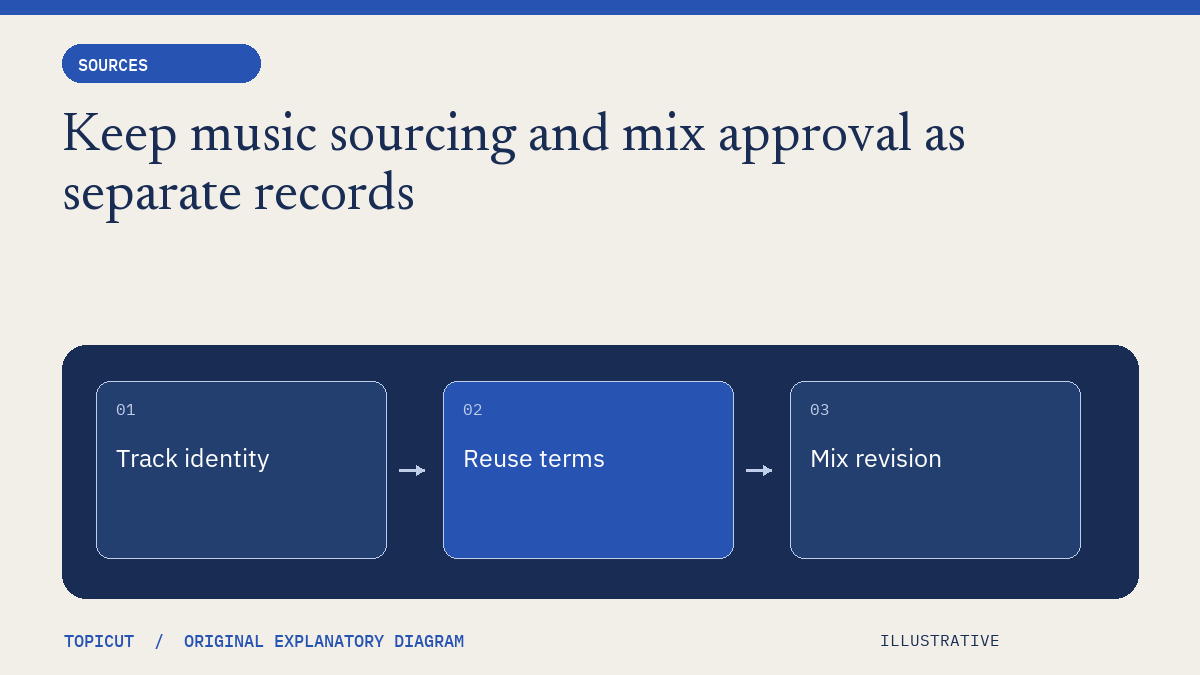
Keep music sourcing and mix approval as separate records
A soundtrack can pass a listening review while still lacking a complete source record.